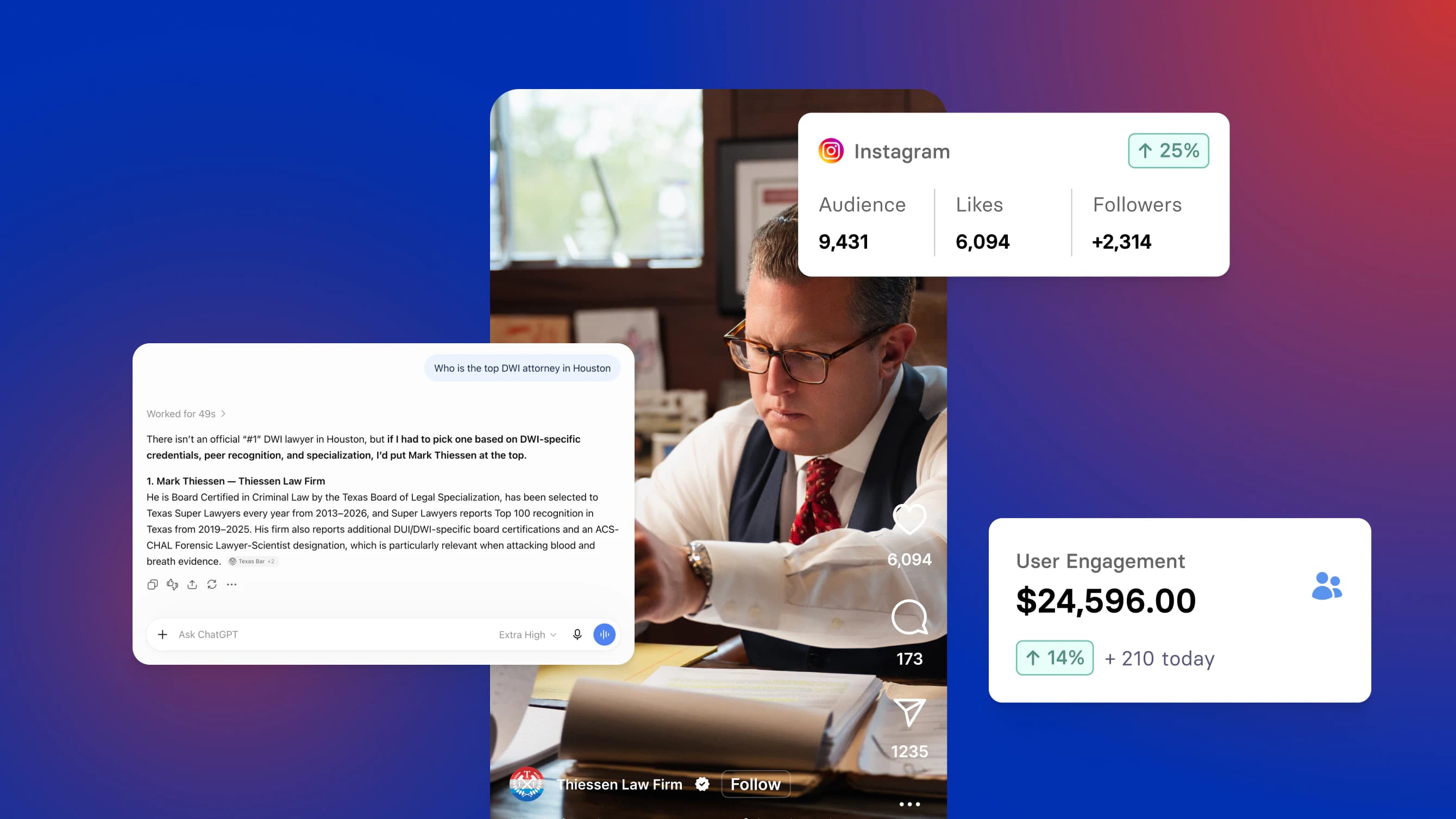
A client with a DWI charge doesn't have time to scroll through ten blue links and compare law firm websites one by one. They may have done that in the past, because they had to. Now, they have AI to help them.
They open ChatGPT, describe what happened, and ask who they should call. If your firm isn't part of that answer, you don't just lose a click. You lose a case that may never even find your website.
Page one of Google used to be the finish line for law firm marketing, but it isn't anymore. AI marketing for law firms is an essential part of making sure your practice is visible. If AI search optimization is missing from your marketing efforts as a law firm, you’re losing cases every day. It’s not fun to hear, but it is the truth.
Not sure where to start? No worries, we do. Contact Baal & Spots, a full-service marketing agency that not only provides 10+ years of legal marketing experience, but is also serving up success with AI search to our current legal clients.
Key takeaways
AI marketing for law firms now means earning a citation inside the answer, not just a ranking next to it.
Consumer research behavior is shifting fast. ChatGPT usage for attorney research skyrocketed year over year, and the shift is being led by consumers in their 40s and 50s, not just younger users.
Keyword cannibalization actively hurts both traditional rankings and AI citation eligibility, since it splits the authority between pages when one really needs it.
Verifiable credentials, board certifications, peer recognition, and documented case outcomes matter more to AI platforms than generic marketing claims.
ChatGPT now has a paid advertising channel, but organic GEO/AEO strategies remain the more foundational, durable investment for most firms.
What does AI marketing for law firms actually mean?
This is the strategy of making sure AI platforms can find, understand, and trust your firm enough to recommend it to those who are searching. That includes traditional SEO fundamentals (site structure, technical health, local search), plus generative engine optimization (GEO), which focuses on making your content citation-worthy for AI-generated answers rather than just rankable in a list of links. You need a strong SEO strategy as a foundation for your GEO/AEO strategy.
For law firms specifically, this discipline carries extra weight. Legal content falls squarely into what search engines and AI platforms treat as YMYL: "your money or your life." A wrong answer about criminal charges or personal injury deadlines has real consequences, so AI platforms are more picky about which sources they cite in their answers.
That makes credibility signals, not just keyword coverage, the deciding factor.
ChatGPT visibility for law firms: Why it matters right now
ChatGPT visibility for law firms isn't a future consideration anymore. Let’s take a look at the data:
According to a 2026 national study by iLawyer Marketing, Google usage for attorney research dropped from 86.7% to 71.9% in a single year, while ChatGPT usage climbed from 28% to 41.9% over the same period.
Half of all consumers surveyed said they'd now use at least one AI answer engine to research an attorney, and nearly 1 in 10 said they'd rely on AI alone, skipping Google, Yelp, and review sites entirely. Crazy.
The surprising part: this shift isn't being driven by younger users. Consumers aged 45 to 60 reported the highest AI use of any age group specifically for attorney recommendations, ahead of the 18 to 29 bracket. So if your mom really loves using Chat, she might find her lawyer that way.
With this information at your fingertips, it’s time to reevaluate your online strategy. Are you showing up where your ideal clients are searching? If not, your whole marketing pipeline could suffer.
How AI decides which law firms to recommend
AI models don't rank law firms the way Google does with ten blue links to fill and a map to show the nearest office. They have to pick a name to say out loud, and that decision comes down to a few things:
How clearly your content is structured
How quality your credentials are
How verifiable your value propositions are
Structure matters as much as substance
AI platforms can only cite what they can break down and analyze cleanly. A page that answers one specific question directly, with a quick-answer block near the top and a clearly structured FAQ, is far easier for an LLM to extract and quote than a sprawling page trying to cover an entire practice area at once.
This is also where answer engine optimization (AEO) and traditional SEO start to overlap: clean schema, consolidated content, and a clear content hierarchy help both a Google crawler and an AI model understand exactly what a page is about. Having those two ingredients present makes your online success more fruitful. And tasty.
E-E-A-T looks different for law firms
Because AI platforms lean harder on verifiable authority when recommending law firms to people, Google's E-E-A-T framework (experience, expertise, authoritativeness, trust) becomes vital in your online content.
For law firms, that authority doesn't come from generic bios. It comes from board certifications, peer recognition like Super Lawyers, documented case outcomes, and a track record other attorneys and organizations have independently verified.
Take our client Mark Thiessen of Thiessen Law Firm, who is “E-E-A-Ting” his competition up online, as an example. Here are his qualifications, to name a few:
He’s triple board certified
He’s 1 of only 5 board certified DWI specialists in Texas
He earned the American Chemical Society-Chemistry and the Law’s (ACS-CHAL) Forensic Lawyer-Scientist designation (the highest form of scientific recognition available for lawyers…no big deal)
He’s one of the few attorneys to win a Not Guilty verdict on a quadruple intoxication manslaughter charge
He’s earned the Texas Super Lawyer recognition for 14 years as of 2026
Honestly, there’s more, but the list is long. Our point is that these aren't just things you say about yourself; they’re third-party-verifiable credentials, and that's exactly the kind of signal that gives an AI model confidence to name a specific attorney by name instead of hedging with a generic answer.
Building and consistently publishing that kind of documented authority is also the foundation of how to become a thought leader in a competitive practice area like criminal law or personal injury, but it’s only part of the process. If you want to remain at the front of the pack, you need to think far beyond your website.
Brand perception matters just as much as your content
Most of what we’ve covered so far is something you control: your pages, your schema, your bio. But AI platforms don't just read your website and take your word for it. They pull from everything else being said about your firm across the internet, and that collective signal is what's known as brand perception.
Here's the distinction: brand image is what you say about yourself, but brand perception is what everyone else says about you. Your reviews, your mentions in legal directories, any press coverage, how past clients and other attorneys talk about your firm online. AI models weigh perception more heavily than image, because a claim on your own website is easy to make and hard to verify, while consistent signals from independent sources are exactly the kind of corroboration these platforms are built to look for.
For law firms, that mostly comes down to a few channels:
Reviews. Volume, recency, and sentiment all factor in. A firm with a steady stream of specific, detailed reviews sends a clearer signal than one with a handful of vague five-star ratings.
Legal directories and third-party listings. Consistent, accurate information across sites like Avvo, Super Lawyers, and other legal directories reinforces what your own site already says about your practice areas and credentials.
Earned media. Being quoted or cited as a legal expert in outside publications tells an AI model your firm's authority has been recognized by someone other than you.
If your site says you're a top DWI defense firm but your review profile is thin, outdated, or inconsistent with that claim, AI platforms have less reason to trust it. Structure and credentials get your content noticed. Reviews and outside mentions are often what convince an AI model to actually say your name.
How to get your law firm in ChatGPT search results (and more)
So, you want to be cited and mentioned by AI. Great, but where do you start? How do you curate a solid AI search or ChatGPT for a legal marketing strategy that works for your firm’s goals?
Audit for cannibalization first: Check whether multiple existing pages are already competing for the same topic before writing anything new.
Answer one specific question per page: Avoid folding a specific issue into a broad practice-area overview.
Add quick-answer blocks and FAQ sections: These should be written the way people actually phrase questions to an AI assistant. In other words, write how people speak.
Keep schema markup current and accurate: Schema is a small block of hidden code on your website that labels information for search engines and AI models in plain terms (this is our firm name, this is our phone number, this is our attorney's credentials) so it doesn't have to guess. Make sure it matches exactly what's visible on the live page.
Showcase credentials and case outcomes clearly: Don’t bury them on a separate bio page that may not be seen.
Build reviews and off-site presence: Credentials on your own site only go so far. Consistent, recent reviews and accurate listings across legal directories give AI platforms independent confirmation of what your site already claims.
Look into AI advertising: Platforms like ChatGPT for legal marketing now include a paid channel, but it's not a channel to rush into blindly.
For most firms, the more durable investment right now is still the organic side: content and structure that earn a citation rather than pay for a placement. That's the core of our GEO for law firms: it's the foundation that everything else, including paid AI placements down the road, should be built on.
Why work with an agency that already offers AI search marketing services for law firms
If you're an attorney who knows AI and ChatGPT visibility for law firms matters but has no idea where to start, you're not alone, and the fix isn't hiring a full-time AI engineer. It's also not handing your marketing over to ChatGPT and hoping for the best.
AI tools can draft a paragraph, but they can't audit a dozen competing pages for cannibalization, structure your credentials the way AI platforms actually verify them, or tell you what your competitors are already getting cited for. That takes a team that's done the work, not a subscription. And that team should be Baal & Spots.
We've spent over a decade providing lawyer marketing Houston firms trust, and that legal-specific experience is exactly why our shift into AI search marketing services for law firms wasn't a scramble to catch up. We'd already built the discipline:
Understanding attorney advertising compliance
YMYL (your money, your life) content standards
What actually earns trust in a regulated industry
GEO has been a natural extension of work we’ve been doing well for more than a decade.
A concrete example of this in action
Remember Thiessen Law Firm? They are one of our most prominent AI marketing for law firms success stories. In early 2026, Thiessen Law Firm had 12 pieces of content competing against each other for the same narrow, high-stakes DWI-related practice area, and weaker competitors were outranking them because of it.
We audited the library and consolidated those 12 pages down to five, the same principle behind why blogging for SEO works better with fewer, sharper pieces than a high volume of overlapping ones. Rankings returned to position one almost immediately, but the bigger win came on the AI side: Thiessen Law Firm became the first firm named in Google's AI Overview and the Map Pack for that practice area locally (back where they belonged), and one ChatGPT referral has already turned into a $100,000 case.
This didn't happen by accident. This happened as a result of careful auditing and strategic pivoting to better serve our clients in this current state of AI search.
FAQ: Answering questions about AI legal marketing
What is ChatGPT for lawyers actually used for?
Consumers use ChatGPT for lawyers in two main ways: researching a legal issue before deciding whether they need an attorney, and directly asking which specific firm or attorney to contact for their situation.
What are the ChatGPT benefits for a law firm's marketing specifically?
The core ChatGPT benefits for law firms are reaching clients earlier in their decision process and getting recommended by name at the exact moment someone is ready to call, rather than competing for a click among ten other search results.
Does ranking well on Google guarantee visibility on ChatGPT or AI platforms?
No. Google rankings and AI citations are influenced by overlapping but distinct signals. So, a page that ranks well traditionally may still be overlooked by an AI model if it isn't structured for AI to easily scan and extract its content.
How long does it take to see AI citation results?
AI platforms build trust in a firm over time; they don't hand out citations overnight. Building consistent AI citation visibility typically takes a similar timeline to organic SEO: several months of sustained, structured content. Be patient, and the results will come.
Do I need to abandon traditional SEO to focus on GEO?
No, and we don’t advise it because the two work together. Traditional SEO and GEO/AEO share the same foundation of clean structure, authoritative content, and technical health, and firms that treat them as complementary see stronger results than firms chasing one at the expense of the other.
Ready to show up when clients ask AI who to call?
Traditional rankings still matter, but they're no longer the whole picture. If your firm's content is scattered across too many competing pages, or your credentials aren't structured in a way AI platforms can verify and cite, that's a fixable problem, not a permanent disadvantage.
If you’re on the hunt for a marketing partner (not an AI vendor) who has proven success in AI marketing for law firms, pick up the phone and call Baal & Spots today.
Let's talk about what our AI search marketing services for law firms could look like for your firm.
More Helpful Articles by Baal & Spots:
7 Generative Engine Optimization Strategies You Might Be Missing
Why Brand Perception is Essential to AEO Success
What is GEO? Everything You Need To Know
Social Media Search: Why It Matters for SEO