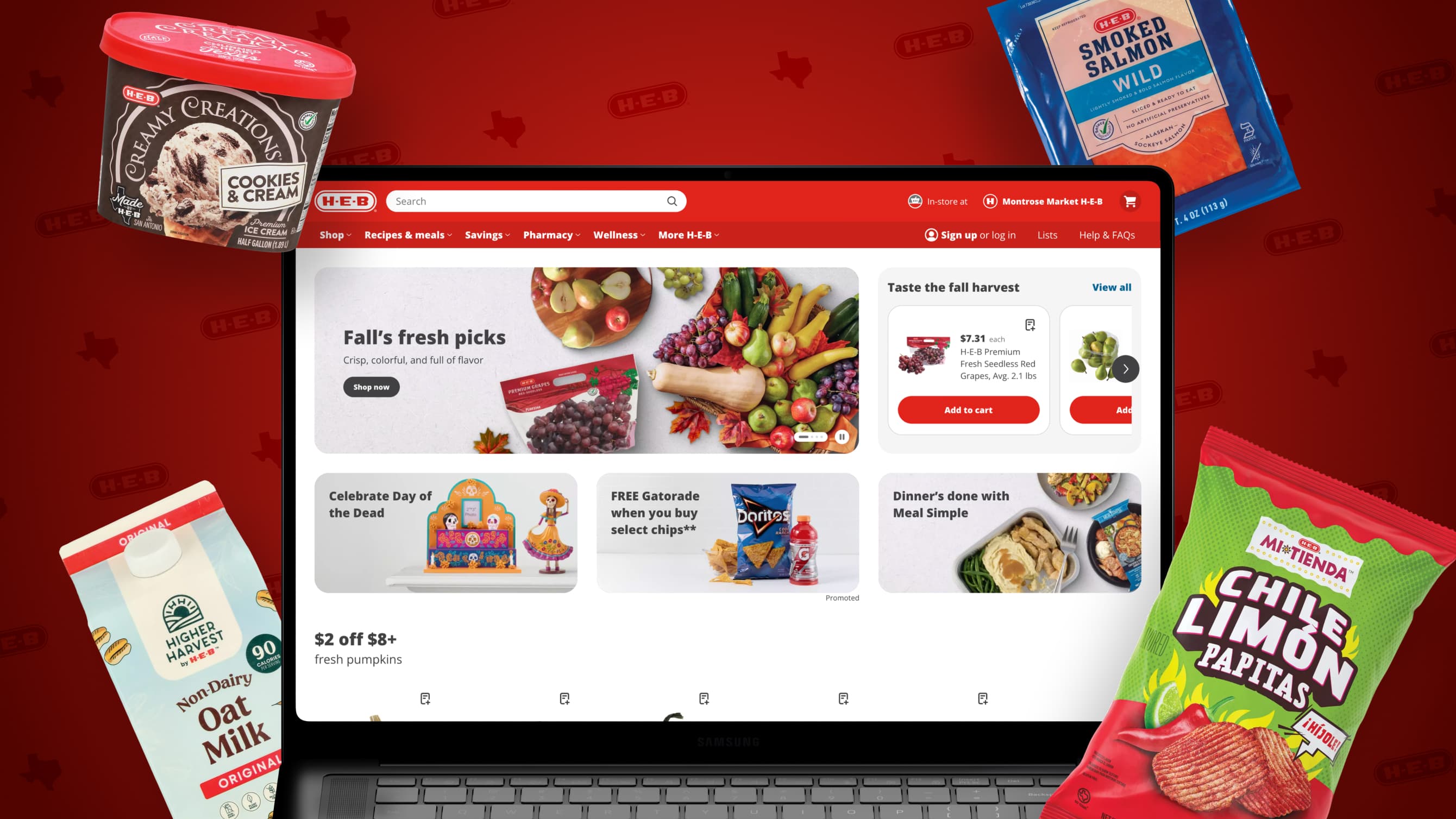
Nobody brags about their grocery store. Nobody except Texans. While the rest of the country has to rely on bland, boring, and just downright sad supermarket chains to do their Sunday shopping, Texans get an entirely different experience. Instead of dragging their feet down the aisles, they stop and smell the freshly baked tortillas.
That’s right, we’re talking about H-E-B.
Forbes once called H-E-B “The Smartest Supermarket” in America and claimed that they even dethroned Trader Joe’s as the country’s favorite grocery store. People often ask, “Why are Texans obsessed with H-E-B?” when they should be asking, “What is H-E-B doing that other grocery store brands aren’t?”
As Texans, we fully understand the H-E-B hype. But as a CPG marketing agency based in Houston, we have a deeper understanding of why this store lives up to it. Similar to our Buc-ee's brand case study, we believe that H-E-B’s success is rooted in brand perception and how it built an experience unlike any other store.
Here, everything is better thanks to strong branding.

The beginning of the brand
Before we fully dive into the H-E-B brand, here’s a little history lesson from the Texas State Historical Association. Florence Butt opened Mrs. C.C. Butt's Staple and Fancy Grocery (geez, that’s a mouthful) in Kerrville, Texas, in 1905.
Her son Howard Edward Butt took over the family business and attempted to put his own spin on it. He added meat deliveries and a self-service cash-and-carry policy, calling it C.C. Butt Cash Grocery. Yeah, the Butt family were not gifted in name branding. But after some trial and error, Howard opened his first air-conditioned, full grocery store in San Antonio in 1942, and slapped his initials on the sign: H-E-B.
Over the next century, the company expanded across Texas, grew into the fifth-largest private business in the country, and brought in tens of billions of dollars annually.
What makes H-E-B so successful?
So, why are Texans obsessed with H-E-B?
For starters, the stores themselves provide a unique experience. Clean, lively, and packed with personality, an H-E-B feels more like a community hub than a grocery store. The fresh prepared foods, in-store bakery, and thoughtfully curated product selection make it the kind of place you actually want to spend time in, not rush in and rush out. As they say, “it’s just a vibe.”
Then there are the private label products. From Horchata Crisps to cheddar Lone Stars, H-E-B's in-house line is priced competitively and designed with the kind of care most grocery store brands never bother with.
If you were to ask, “What is H-E-B known for?” most would say their tortillas. We can smell them now; they're imprinted into Texan collective memory. The store-made flour tortillas have become so legendary that Texans have been known to stuff their suitcases with them when leaving the state. They even have a scented candle to give off that buttery scent even if the tortillas weren't on your grocery list that week.
But ask a Texan what H-E-B means to them, and the answer rarely stops at the bakery aisle. It's the commercials starring hometown athletes. It's trucks rolling into flood zones and hurricane paths before some state agencies even mobilize, stocking up disaster relief supplies and setting up mobile kitchens. People don't talk about H-E-B like a grocery store. They talk about it like a member of the community.
In short, H-E-B provides a good experience with good products, but then again, so do a lot of other stores. What sets them apart is everything they do that has nothing to do with the products at all. Here is why everything is better at H-E-B.
How to create a cult following: Make your audience feel seen
Most brands in H-E-B's position would have gone national by now, and the demand definitely exists from shoppers across the country. Plenty of Texans who have moved to other states would happily pay a premium for H-E-B tortillas. So why haven’t they brought their business to other states? Well, because they’re focusing on who they built it for.
"We are Texans who like to take care of Texans. We still have a lot to do in Texas, and we are going to keep taking care of Texans."
Lisa Helfman, Managing Director of Public Affairs for H-E-B Houston
That is basically the entire H-E-B brand positioning in two sentences. Unlike Buc-ee's, which has expanded into other states, H-E-B has stayed within Texas borders, with one notable exception being Mexico, where the cultural connection to South Texas runs deep. This is an extension of the same audience, not a departure from it.
When a company commits completely to one audience, that audience commits back. H-E-B knows that being the best for Texans is worth more than being average for everyone else.

How this philosophy shows up in their stores
When you walk into an H-E-B, everything from product selection to store layout to local brand spotlights screams South Texas. First, they built their brand by supporting other businesses through their annual Quest for Texas Best competition. They invite Texas business owners to compete for shelf space in H-E-B stores, while also giving local entrepreneurs training, resources, business support, and visibility they may not have had before.
This brand-building initiative also happens to make the store feel more alive, more local, and more distinctly Texan with every passing year. The marketing takeaway is this: knowing your audience deeply enough to build everything around them is a positioning decision that pays off in loyalty most brands never achieve. It’s not about limiting accessibility. It’s about being there for those who need you most.
Private labeling done right: When store brands become real brands
Most grocery store brands use private labeling as a way to be the cheapest option in the store. When the name-brand product is out of stock, you have the poorly branded and utterly forgettable alternative that doesn’t give you the same experience. H-E-B's private label is entirely different.
H-E-B’s shelves aren’t lined with knock-off products with generic labels slapped on them. They look as if they belong there, because they blend in seamlessly with companies that pay millions for unique branding.
The packaging for each brand is designed with distinct personalities.
The development team focuses on regional cuisine, and makes products that Texans love and use every day.
The products look as professional and vibrant (sometimes even nicer) sitting next to household names so that they aren’t overlooked.
Their lineup of in-store brands is so successful that it can stand on its own. Creamy Creations is just as recognizable to Texans as Blue Bell or Ben & Jerry’s. And those two don’t even have a Honey Sopapilla flavor.
These H-E-B brands are so recognizable that they made their own soccer jerseys for the World Cup as a giveaway prize, and customers begged them to release them in stores. Still dreaming about the Mi Tienda design.
Compare that to the Up & Up line at Target, where the branding is nearly identical across the board with consistent color coding and very little personality. It communicates one thing clearly: this is the budget option. H-E-B's private label communicates something else entirely: this is something we're proud of.
When quality doesn't need a discount
Not only do their in-store products stand alone, H-E-B also keeps costs consistently competitive across both national brands and private label products. In their stores, shoppers aren’t choosing their products because they’re cheaper; it’s because they’re actually good. Maybe even better.
The marketing takeaway: private label is one of the most underutilized branding opportunities in retail. H-E-B treats every in-house product like it deserves its own identity, and the result is a product line that builds brand loyalty rather than just protecting profit margins.
Platform-specific social media: What tailored content actually looks like
Most brands say they tailor their social media content to each platform, but H-E-B actually does it right.
Their Instagram is polished, product-forward, and visually consistent, the kind of feed that looks like it was shot intentionally, not pulled from a stock library.
Their TikTok leans into humor, trending audio, and in-store moments that feel relatable because they are.
Their X and Facebook presence focuses on branded collaborations and community conversation, the kind of content that gets shared between neighbors rather than liked by strangers.
None of it looks AI-generated. None of it feels over-produced or a cookie-cutter replication of what other brands are doing. It looks like people who actually shop at H-E-B made it, which is exactly the effect a brand should be going for.
Why human-made content wins
This matters more than it used to. Social media search has transformed platforms into search engines, where users go not only to discover new brands, but to see if they live up to the hype. An authentic TikTok reaches a different part of that audience than an Instagram carousel that captures the beauty of their food products. H-E-B understands that the same person behaves differently on different platforms, and their content strategy reflects that.
H-E-B's social presence stops the scroll because it feels real, and it also feels fun. When summer kicked off, instead of plastering “summer sale” on every graphic, they made pool floaties of some of their famous items. Cute and conversational.
Learning how to tailor social media content to each platform is one of the most important things a brand can do, and H-E-B is a textbook example of how it's done well.
The marketing takeaway: platform-specific content isn't about reposting the same thing in different formats. It's about understanding how your audience shows up on each platform and meeting them there with content that fits the context.
What CPG and retail brands can learn from H-E-B
H-E-B didn't become Texas' most beloved brand by running better ads. They did it by making decisions at every level of the business that reflected a consistent set of values: build your brand around your audience and make products worth being proud of. That's a harder strategy to execute, and it’s why most brands don’t do it.
Here's what any CPG content marketing strategy can take from H-E-B:
Define your audience and build everything for them
Treat your private label products like real brands with real personalities, not budget alternatives
Tailor your social media to how your audience actually behaves on each platform, not just where they happen to be
Let your community tell your story and earn the right to have them do it
Forbes was right to call H-E-B the smartest supermarket in America, but the smartest thing H-E-B has ever done isn't a product or a promotion: it's the discipline to stay true to who they are and who they serve, no matter how big they get.
The H-E-B brand is, and always will be, so much more than a grocery store. And now you know why.
Is your brand weighing you down? Contact the branding experts at Baal & Spots.
As a Houston-based consumer goods marketing agency that specializes in integrated marketing, we know why H-E-B is a masterclass in in-store branding and online presence. Every decision they ever made centered around who they served, the key to not only retaining customers, but creating lifelong ambassadors. With the right brand strategy, your business can shine amongst the competition.
If you’re searching for one of the best agencies for CPG brand marketing, Baal & Spots can help you develop a brand identity that attracts your ideal customers by demonstrating who you are at every touchpoint. Let’s talk.
More Helpful Articles by Baal & Spots:
Why a Brand Refresh Might Be Better than a Rebrand
How To Maintain Brand Authenticity in the AI Era
7 Expert Tips for Multi-Location Marketing
Tips for Making Social Media Videos No Agency Will Tell You
Common Marketing Challenges Business Owners Face